Sew cloth napkins with neat square corners
Sew a small set of washable napkins with consistent folds, checking one finished sample before cutting the rest.
Start with the fabric's everyday job
Napkins need to absorb, wash and feel comfortable against skin. A washable woven cotton or linen blend is a straightforward starting point, but check the care instructions and any finish on the fabric. Very slippery or heavily coated material can be frustrating even if its pattern is attractive. Prewash and dry as you expect to care for the completed napkins before measuring.
Decide on a finished size by folding a paper square beside your usual plate. A generous dinner napkin and a small breakfast napkin serve different purposes. Add enough fabric for a double-fold hem on every edge. Write the cutting size down and make one sample before cutting an entire length into squares.
Square the piece before hemming
Press the fabric and align the cut with its grain. A square cut at an angle may twist after washing even if the edges were measured carefully. Use a ruler and suitable cutting tools on a protected surface. Keep the offcuts until the first napkin is finished; they are useful for testing stitches and pressing settings.
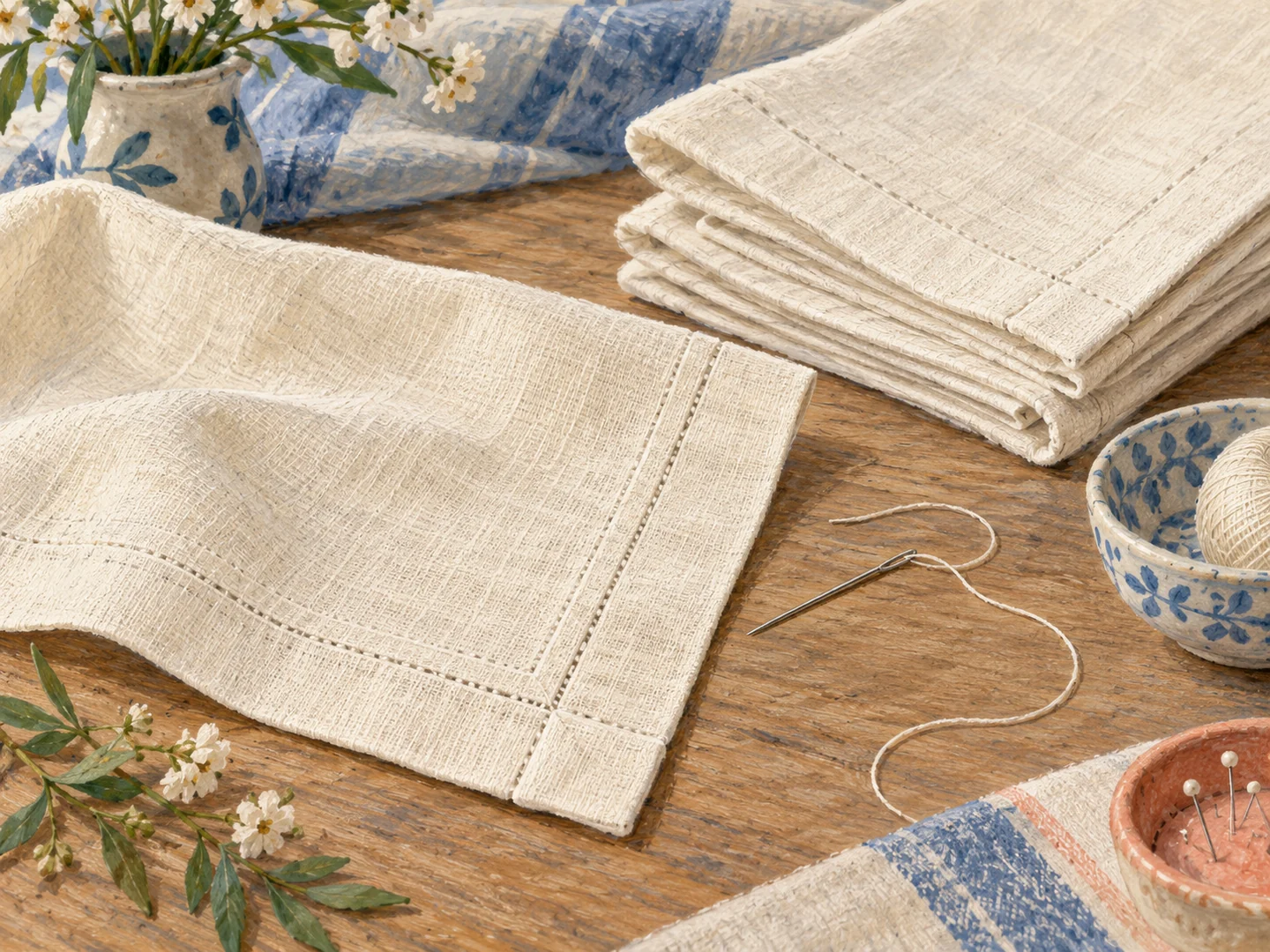
Fold a narrow edge to the wrong side and press, then fold again to enclose the raw edge. Keep the width consistent with a small measuring guide. At each corner, arrange the folds neatly so no raw fabric protrudes. A simple overlapped corner is acceptable for a beginner if the thickness stays manageable; a mitered corner takes more marking but reduces bulk.
Directional prints need attention before several squares are cut from the same length. Decide whether the motif should face a particular way when folded at a place setting. For a small-scale all-over print, this may not matter at all. Make that decision once and mark the wrong side discreetly if needed, so the sewing process does not introduce avoidable variation.
For a miter, practice on an offcut or follow a sewing reference suited to the exact hem width. Do not trim the corner until the folded lines and seam position make sense. It is easy to remove too much material and leave a gap where the edges should meet.
Stitch one controlled circuit
Choose thread and a needle suitable for the fabric, and test the machine tension on the same number of layers. Stitch near the inner folded edge, guiding rather than pulling the cloth. Stop with the needle down at a corner, raise the presser foot and turn the fabric carefully. Secure the stitching ends as appropriate and trim loose threads.
Press the finished napkin, then wash it once to see how the fabric and hem behave. A little softening or wrinkling may be part of the material's character. Twisted edges or a hem that opens need attention before you repeat the process across a whole set.
Cut the remaining pieces only after that test. Napkins do not need to match every item on the table; two related fabrics can make a usable mixed set. Store them where meals are set up so they are easy to reach, and keep a spare rather than planning a set with exactly the number needed for every seat.