Finish tile coasters so they do not scratch the table
Choose smooth tiles and a continuous protective underside so a small coaster does not leave a scratch where a glass once stood.
Inspect the tile before decorating it
A coaster needs a flat, stable surface and edges comfortable to handle. Use intact tiles without chips, sharp corners or cracks. A strongly textured tile may make a narrow glass wobble, while a very porous tile can absorb spills unpredictably. Place an empty glass on the sample and check it from several directions before making a set.
Avoid cutting tile for this small project unless you have the correct equipment and skills. Buying a suitable finished size is simpler than turning offcuts with rough edges into something used on a dining table. Wash away dust using a method appropriate to the tile and let it dry completely before adding anything underneath.
Cover the contact surface
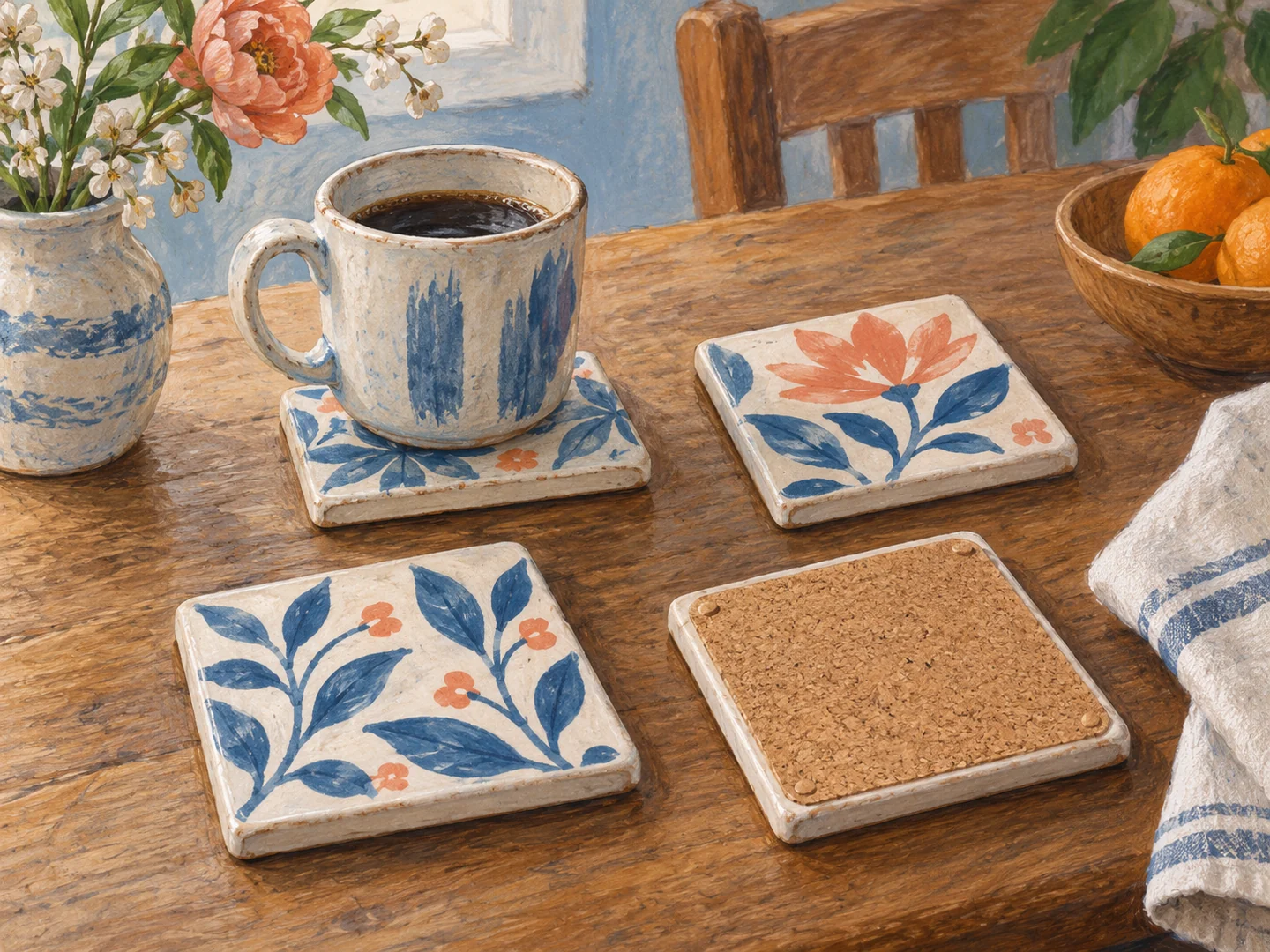
The unglazed back of a tile can be abrasive. A thin sheet of suitable cork or another protective backing can cover it more evenly than four tiny dots, provided the adhesive and materials are compatible. Cut the backing slightly inside the outer edge so it is not conspicuous, but large enough to support the coaster without rocking.
Follow the adhesive's instructions for preparation, ventilation, pressure and curing. Test on one tile before assembling several. An adhesive that grips ceramic but bleeds through cork may mark the furniture; the whole combination matters. Keep the coaster flat while curing if the product calls for it.
Check that the backing has no hard particles trapped in it. A grain of dried adhesive or grit can scratch despite the soft material around it. Run a hand over the underside, then test the coaster on a protected surface with a cool drink. Look for moisture transfer and slipping before trusting it on a valued table.
Decoration changes the maintenance
If adding a paper design or painted motif, use a system suitable for the tile and intended exposure to condensation. A generic craft sealer does not automatically make paper waterproof or resistant to a hot mug. For the least complicated version, let the tile's existing pattern be the decoration and leave the glazed top unchanged.
Wipe the coaster as its materials allow, and let it dry rather than stacking it wet. Do not put it in the dishwasher unless every component is explicitly suitable for that treatment. Replace backing that becomes detached, gritty or badly compressed.
A coaster is not a trivet for cookware. Keep this project for cups and glasses within the limits of the materials you selected. Making a small set from two related tile patterns gives enough variety without adding another layer of paint, paper and coating to maintain.