Separate everyday craft supplies from grown-up tools
Keep a small set of age-appropriate materials available while storing sharp tools, chemicals and small components separately.
Decide what can be used without fetching an adult
The answer depends on the child, the material and the activity. Paper and suitable coloring tools may belong in an accessible tray, while scissors, adhesives, beads and specialist tools may require supervision or secure storage. Follow product age guidance and the CPSC's art-material safety advice. A container labeled "Kids' crafts" does not make every item inside appropriate for every child.
Take an inventory on a clear surface when children are not reaching into the sorting area. Separate ordinary working supplies, adult tools, incomplete kits and materials that are damaged or no longer usable. Keep products in original labeled packaging where instructions and warnings are important. Do not decant glue, solvents or pigments into food containers for a coordinated look.
Build an everyday tray
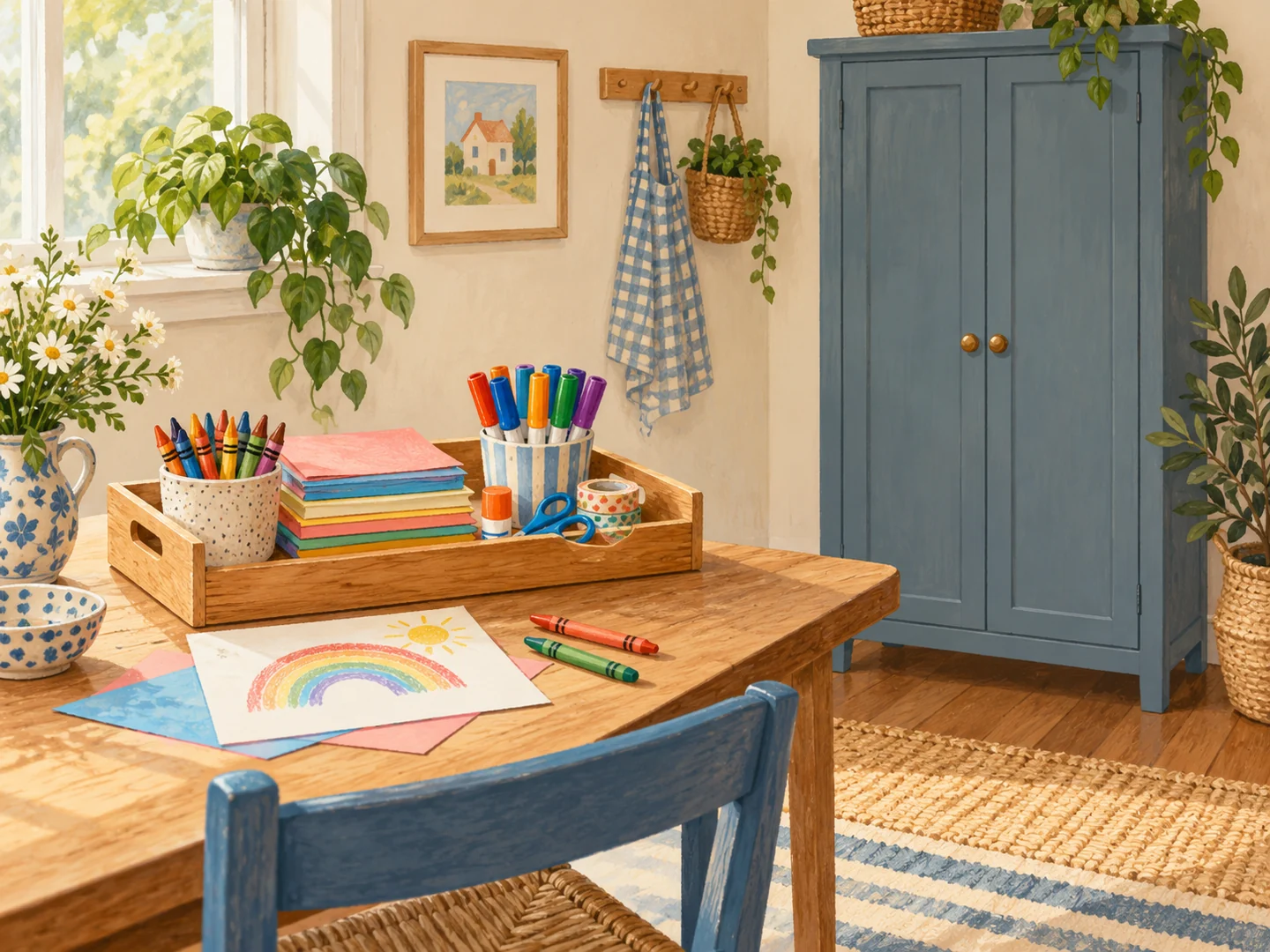
Choose the materials used most often and provide a modest working quantity. A stack of paper, a few crayons or pencils and one current activity may be enough. Keep the tray light enough to move off the table, with compartments that allow contents to be returned without exact arranging. A child should not need to sort twenty shades into a specific order before cleanup is considered finished.
Test containers with the actual objects. Long brushes do not fit comfortably in a short pencil cup, and a deep bin can hide small packets beneath large paper. Keep paper flat where possible and protect it from leaks. Washable does not mean a material can be used on every surface without damage, so provide a suitable work covering and read the label.
Keep the replacement stock distinct from the working tray. A large multipack of markers does not all need to be opened at once, and loose duplicates can make it harder to find the color that still works. When replenishing, test the old item first and remove it if it is unusable. That prevents the accessible collection from expanding simply because supplies were bought in bulk.
Separate supplies by how they are used rather than by every possible color. Drawing materials can stay together, while collage pieces may need their own container. A few broad categories are easier to maintain than a drawer divided into tiny cells for a growing collection of offcuts.
Give adult tools their own storage
Craft knives, hot-glue equipment, needles, staple guns and similar tools belong in secure storage with their accessories. Keep blades and small fasteners contained, and follow the tools' instructions for cooling, unplugging and maintenance. An upper shelf alone may not be sufficient if children can climb to it. Choose access control suitable for the household.
Plan the work location for activities involving heat, sharp edges, dust or fumes. The dining table may be fine for drawing but unsuitable for another process. Product-specific ventilation and protective equipment requirements still apply to a small craft. If those conditions cannot be met, choose a different activity rather than reducing precautions because the project is short.
Store small components away from younger children and pets, including pieces belonging to an older sibling's project. A shared craft room may need a secure project box that can be closed between sessions. The oldest child's ability to use a material does not determine the youngest child's access to it.
Make room for work in progress
A tray or shallow box can hold one unfinished project with its essential pieces. Label it with the owner's name and a date or short description if several projects coexist. Keep wet paint or adhesive where it can dry under the product's conditions before enclosing it. A lid is not a solution for a project that still needs airflow.
Set a realistic limit on ongoing work. If every available surface holds something unfinished, review which projects are still wanted. Save a useful component, photograph a temporary construction or let go of a stalled idea as appropriate. There is no obligation to complete every activity simply because materials were opened.
At cleanup, return tools first, then materials, then scraps. This sequence keeps sharp or hazardous items from being lost beneath paper. Remove dried-out products through the appropriate disposal route and replenish only what is actually used. A smaller collection with visible contents often invites more making than a cupboard so full that opening it becomes the first challenge.