Pack a homework caddy that moves off the table
Keep the supplies needed for an ordinary assignment in one portable container, with enough empty space to put them back easily.
Pack for the usual work
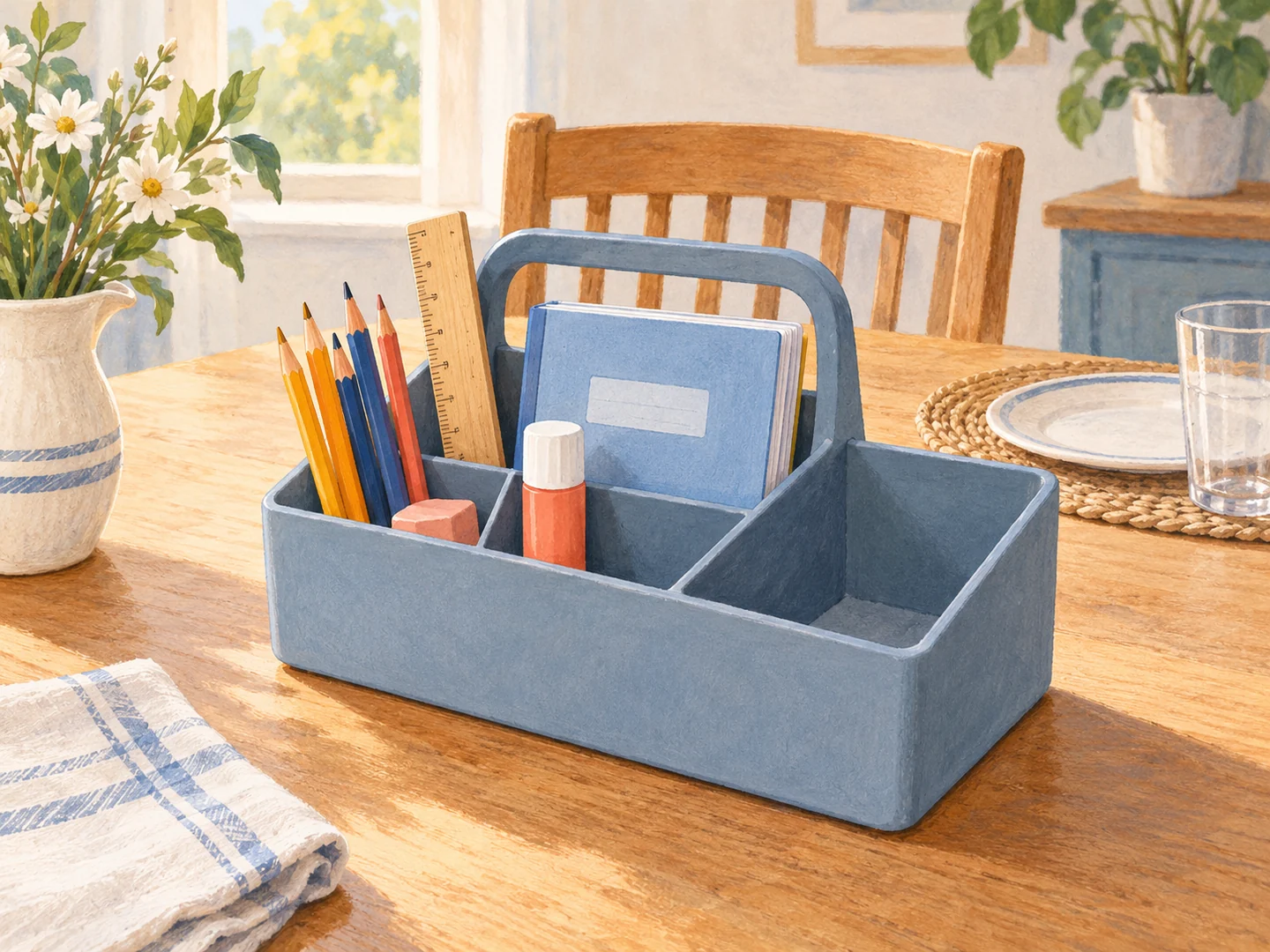
A homework caddy should carry the things used most afternoons, not every school supply in the house. Start with the current assignments and the child's age: perhaps pencils, an eraser, a ruler and a few coloring tools. Scissors, sharpeners and other tools need age-appropriate selection and supervision. Special materials can be brought out when the assignment actually calls for them.
Ask which small frustrations interrupt work most often. A blunt pencil, a missing ruler or an eraser that smears can matter more than a lack of specialty supplies. Fix those first. A caddy assembled from functioning basics may be less colorful than a new stationery set, but it removes the reasons to leave the table repeatedly in the middle of an assignment.
Test a container you already own before buying one. It needs a comfortable handle, a stable base and a size the intended user can carry without spilling. A tall narrow pot may hold pencils neatly but tip inside a larger tray. Short compartments often make the contents easier to see.
Leave the paper somewhere flat
Loose worksheets rarely benefit from being folded into a caddy with glue sticks. Give active papers a flat folder or shallow tray that travels alongside it. Keep completed work separate from blank paper so a finished sheet is not used for drawing on the back. A simple labeled pocket may be enough; a complex filing system can become another assignment.
Try the caddy on the actual table. It should leave space for an open book, writing arm and any required device. Place it within easy reach without making children lean across one another. If siblings work together, shared supplies can sit in the middle while personal folders remain distinct.
Do not add a lamp, charger and extension lead to the portable container just to make it self-contained. Lighting and electrical equipment should have suitable fixed arrangements and clear ventilation. A caddy is for movable stationery, not a bundle of plugged-in equipment crossing the dinner table.
Give it a parking place
Choose a shelf or cupboard close enough that the caddy can move off the table in one trip. Check the loaded height, including pencils, before assuming it will fit. If the handle or contents catch on the shelf above, the system will quickly become a reason to leave it out.
At the end of a session, remove scraps, return completed work to its folder and check that the essential pencil still writes. A short reset is more useful than a perfectly arranged collection of supplies that are dried out or broken. Store spare supplies elsewhere so the working container does not grow heavier each time a multipack is opened.
Adjust the contents when schoolwork changes. A child doing mostly reading and handwriting needs a different kit from one working on geometry. The caddy can remain the same modest container while its contents evolve, keeping the family table available for the next use.