Check the delivery route before ordering furniture
Furniture must pass through doors, turns and stairs before it reaches the room. Check the delivery route with the packaged dimensions and the seller's instructions.

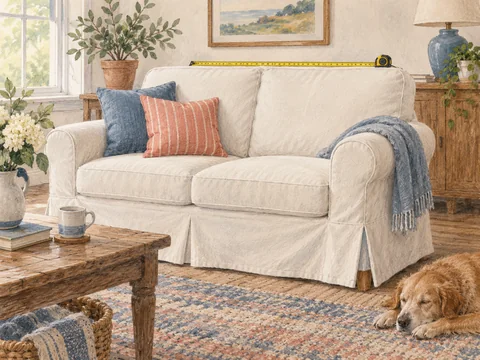
The sofa fits against the living-room wall. That is encouraging, but it does not establish that the sofa can reach the wall. A narrow porch, a tight turn inside the front door or a low stair ceiling can stop a delivery well before the room. Map the route before ordering, including any building entrance, elevator and shared hallway.
Ask which dimensions apply
Find the packaged dimensions, the assembled dimensions and any approved removable parts. Legs or backs may come off on some designs, but do not assume they do because a similar product allows it. Ask the seller what arrives and whether the delivery team is authorized to remove or assemble components. Keep that answer with the order details.
A flat-pack cabinet can be easier to carry through a doorway, yet its longest panel may still be difficult to turn on a landing. Several small cartons also need somewhere to wait while assembly happens. The transport problem changes rather than disappearing entirely. Include package weight and handling requirements, and arrange appropriate help rather than attempting an unsafe lift.
Walk the entire route
Measure clear openings with doors positioned as they will be during delivery. Handles, closers, railings and light fittings may reduce the available space. Note tight corners and the space on both sides of them. A box passing through one doorway in a straight line does not prove it can make an immediate turn afterward.
For stairs, record the width, landing dimensions and overhead clearance along the route. For an elevator, check the door opening and cabin dimensions, then ask building management about booking or protective-cover requirements. These measurements should be shared with the seller or delivery specialist when the fit is uncertain. Simple diagonal calculations are not a guarantee that a large rigid object can be maneuvered safely.
Resolve the tightest turn before ordering
Picture a boxed armchair entering an apartment through a door that opens directly onto a narrow hallway. The carton may be narrower than the doorway but too long to turn once inside. Removing packaging might reduce the dimensions, yet that only helps if the seller permits it at that point and the unpacked chair can be handled safely. Do not assume the delivery crew can unwrap furniture outdoors or leave packaging in a shared corridor.
Send the seller a simple sketch showing the doorway, opposite wall and next turn, with measurements labeled clearly. Photographs can help explain obstructions that a list of numbers misses. Ask whether the delivery team needs additional details or an access survey. A written answer tied to the exact model and service is more useful than a general assurance that they have delivered large furniture before.
If access remains uncertain, consider a genuinely modular alternative whose individual pieces are documented, or a different item. Detachable legs alone may not reduce the critical width. Check how components connect and whether assembly can occur in the room. Avoid plans involving lifting through windows, removing building fixtures or forcing an item through without qualified assessment and any required permissions.
Have a decision point before payment: either the route is confirmed to the degree the seller can assess, an appropriate access service is arranged, or the purchase waits. That is easier than making a rushed decision while a delivery vehicle occupies the street and the furniture is halfway inside.
Understand the delivery service
Curbside delivery, delivery to the threshold and placement in a chosen room are different services. Read what is included, whether stairs cost extra and who removes packaging. If the item must be assembled upstairs, ask whether the service covers that or only carrying sealed boxes. A familiar retailer name does not tell you which service a particular order uses.
Check the procedure and cost if access fails. Some sellers may charge for a refused delivery or collection, and made-to-order items can have separate conditions. Do not rely on the driver being able to solve an access problem on the day. Provide accurate information beforehand and request a professional access assessment where available for a difficult or expensive delivery.
Leave working room at the destination
Mark the furniture footprint in the room, then allow room around it for unpacking and assembly. A tall unit assembled flat may need additional clearance to be raised upright; follow its instructions and anchoring requirements. The final installed height alone does not show that temporary movement.
Before delivery, clear the agreed route and protect surfaces only in ways that do not create slipping or tripping hazards. Secure pets and keep children away from the work area. On arrival, follow the seller's inspection process and document visible damage promptly. A successful delivery is not only about squeezing an object through; it is about getting the correct item into place without preventable damage or unsafe improvisation.