Match food containers to leftovers and available shelves
Build a container collection around the leftovers you actually keep. Matching lids and usable shelf space matter more than the biggest advertised set.
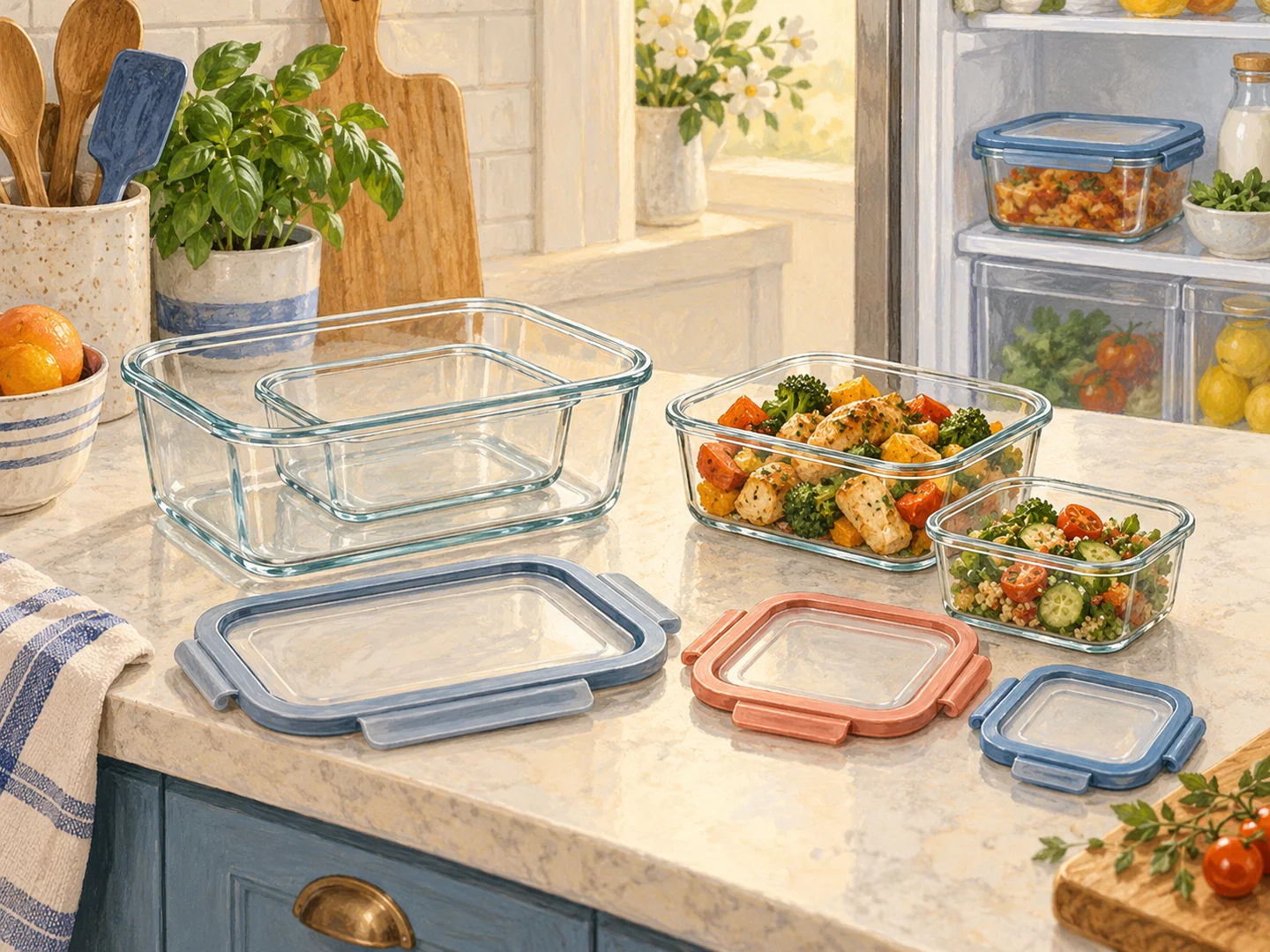
Open the container drawer and pair every base with a lid. Set aside anything damaged or missing its partner according to the material's disposal guidance. Only then decide what is missing. A large new set can add more awkward shapes while leaving the familiar problem of three useful boxes and a dozen unused lids unchanged.
Measure a normal leftover
Think in meals rather than container counts. A portion of soup, half a casserole and a few sliced vegetables need different shapes. Measure the refrigerator shelf where those foods usually go. A broad shallow box may stack well but use an entire shelf depth; a tall jar can be awkward beneath a low shelf. Include the lid's protruding clips in the outside measurement.
Check whether the stated capacity is to the rim or a recommended usable fill level. Allow the headspace specified for freezing or heating when relevant. Do not assume that because a base is microwave-safe its lid is suitable for the same use. Read the instructions for each component, including venting and temperature restrictions.
Compare the collection as a system
A shared lid size across several depths can simplify the drawer, provided the manufacturer actually confirms compatibility. Similar-looking lids are not always interchangeable. Look for clear product names or markings that make a replacement identifiable. A container that requires an unusual lid unavailable separately may be difficult to keep in service after one part fails.
Before replacing everything, test one size for a week. Use it for the meal it was chosen to hold, place it on the intended refrigerator shelf and wash it by the permitted method. Notice whether the lid dries easily and whether the empty parts store without becoming a tower. A successful trial can justify several of the same size; an awkward one can prevent a large matching set from reproducing the problem throughout the drawer.
Decide whether nesting or ready-to-use storage suits you better. Nested bases save space but can become a tower that must be unpacked to reach the middle size. Storing each box with its lid attached takes more room but eliminates searching. A small collection often gives more freedom to choose the arrangement you prefer.
Read the material's limits
Glass, plastic and metal each have specific handling instructions. Check suitability for the freezer, microwave, dishwasher or oven separately; one permission does not imply the others. Avoid sudden temperature changes unless the manufacturer explicitly allows them, and retire pieces whose damage makes them unsuitable for food use. A decorative storage jar is not automatically intended for reheating a meal.
For transport, look at the closure and whether the product is described for liquids. Leak-resistant and leakproof can be used differently, so read the stated conditions. Test a new container with water over the sink before trusting it with soup in a work bag. That test does not replace the instructions, but it can reveal an improperly seated seal or an unsuitable lid.
Choose a few sizes you can recognize quickly. Rectangles may use shelf space differently from rounds, yet the best shape is also one you can fill, wash and put away without frustration. Keep one small area for spare lids and check it periodically. The point of a coordinated collection is fewer decisions when food needs putting away, not a drawer that looks impressive only when every piece is empty.